 As Search Engine Marketing is disrupted because so many people are going to the Large Language Model AI chatbots like ChatGPT instead of search engines like Google, many marketers want to understand how to get found in these models. An interesting new way is via Grokipedia, the new AI-generated online encyclopedia created by xAI.
Grokipedia launched late last year as an alternative to Wikipedia. Grokipedia uses the xAI Grok large language model to create and edit articles rather than the volunteer human editors that create and maintain Wikipedia.
Grokipedia is still a relatively young project, so it's evolving quickly and now is the time to learn about it.
An analysis in The Guardian Latest ChatGPT model uses Elon Musk’s Grokipedia as source, tests reveal says the latest models of OpenAI’s ChatGPT and Anthropic’s Claude cite Grokipedia as a source on a wide range of queries. However, the same article says Grokipedia sometimes repeats misinformation that the Guardian has debunked.
Getting your information into Grokipedia
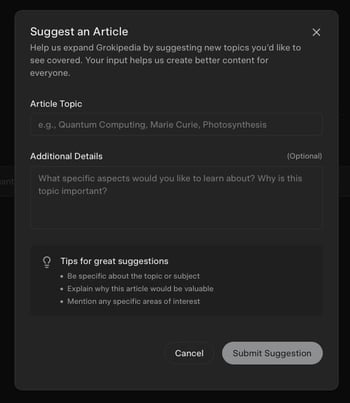 Grokipedia has a tool that allows anybody to suggest new articles. You need to log in to Grokipedia (I use my X / Twitter account) and find the “Suggest Article” button on the top right.
Dylan Haugen has an excellent article titled How To Create And Manage Grokipedia Pages For Clients. In it, he goes through a step-by-step process for marketers. Dylan says: “Unlike a standard blog post or landing page, Grokipedia pages are structured like a public encyclopedia entry. That matters because these pages are built to summarize ‘who the person is’ or ‘what the business is’ in a clean, structured way that aligns with how entity-based search and AI tools organize information.”
While there was already an entry for David Meerman Scott in Grokipedia I worked with Dylan to create new pages for some of my books. The process involved starting from a bulleted list on my main Grokipedia page to suggest individual book pages to Grokipedia. Dylan suggested dedicated Grokipedia pages for each of my books with structured, factual descriptions that he pulled from my website and that would interlink with my main Grokipedia profile. This created an SEO tree, a hierarchical, top-down map of my content. Learn how Dylan did it here.
Check out the Grokipedia entry for Fanocracy.
My friend Dennis Yu, who works with Dylan says: “Grokipedia is strongly cited by ChatGPT and showing up in search. Elon reiterated in the X.ai all hands that Grokipedia would overtake Wikipedia, then continue on to be Encyclopedia Galactica when it has meaningfully documented all entities in the universe. What makes him credible is that he does have the largest supercomputer cluster (MacroHard) in the world with one million GB100 equivalents to gather information. And the most intelligent model (Grok) to process that information, which includes the former Twitter news network.”
Important Note: This article is about understanding Grokipedia from a marketing perspective. I’m not commenting on the use of AI vs. humans to create articles nor am I commenting on Elon Musk, the leader of xAI, and his positioning of Grokipedia content as a “massive improvement over Wikipedia”.
Topics: